01

Spatial Foundation
A trusted spatial reference for the asset, project or network. Bringing models and spatial information together within one governed environment that can be maintained throughout its lifecycle.
ABOUT
Complex environments generate huge amounts of information, but much of it remains split across different systems without a shared spatial context.
01
A trusted spatial reference for the asset, project or network. Bringing models and spatial information together within one governed environment that can be maintained throughout its lifecycle.
02
Understand what’s happening, where it’s happening and what it impacts. Purpose-built tools that turn spatial information into practical understanding across design, delivery and operations.
03
Connected systems and data understood in their real-world context. Creating the relationships between information, assets and activity needed for better analysis, simulation and decision-making.
PROJECTS + APPLICATIONS
From airport-wide spatial environments to focused applications for permits, possessions and operational coordination, each deployment responds to a defined project or operational need.

P
2D + 3D
Permit Coordination
Connecting permits, planned works and asset dependencies to identify spatial conflicts, coordinate activity and understand operational impacts.
Twin Applications · Systems & Data Integration
D
DXB
Airport Spatial Twin
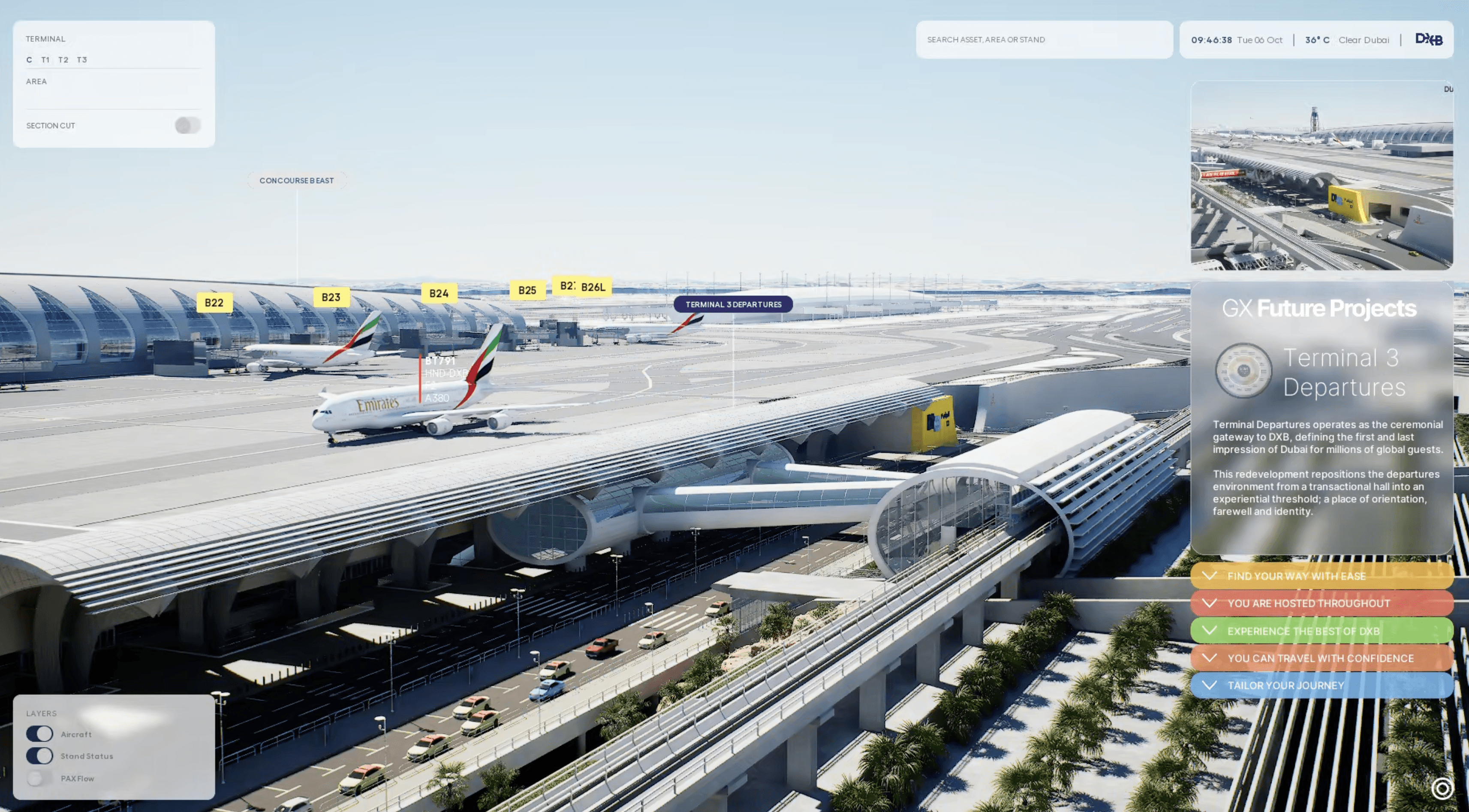
A governed airport-wide spatial environment supporting design, stakeholder engagement and the progressive development of operational applications.
Spatial Twin Development · Twin Applications · Systems & Data Integration · Twin Custodianship

A
AIR + GROUND
Network Context
Exploring how future urban flight networks interact with the city below, including airspace constraints, flight corridors and ground-level risk.
Spatial Twin Development · Twin Applications · Systems & Data Integration

S
3D
Spatial Assessment
Assessing proposed developments and temporary works against protected airspace, making safeguarding constraints and potential infringements easier to identify.
Spatial Twin Development · Twin Applications

E
NETWORK
Spatial Coordination
Connecting rail infrastructure, asset information and planned works to improve visibility and coordination across a complex operational network.
Spatial Twin Development · Twin Applications · Systems & Data Integration
C
DESIGN
Project Development
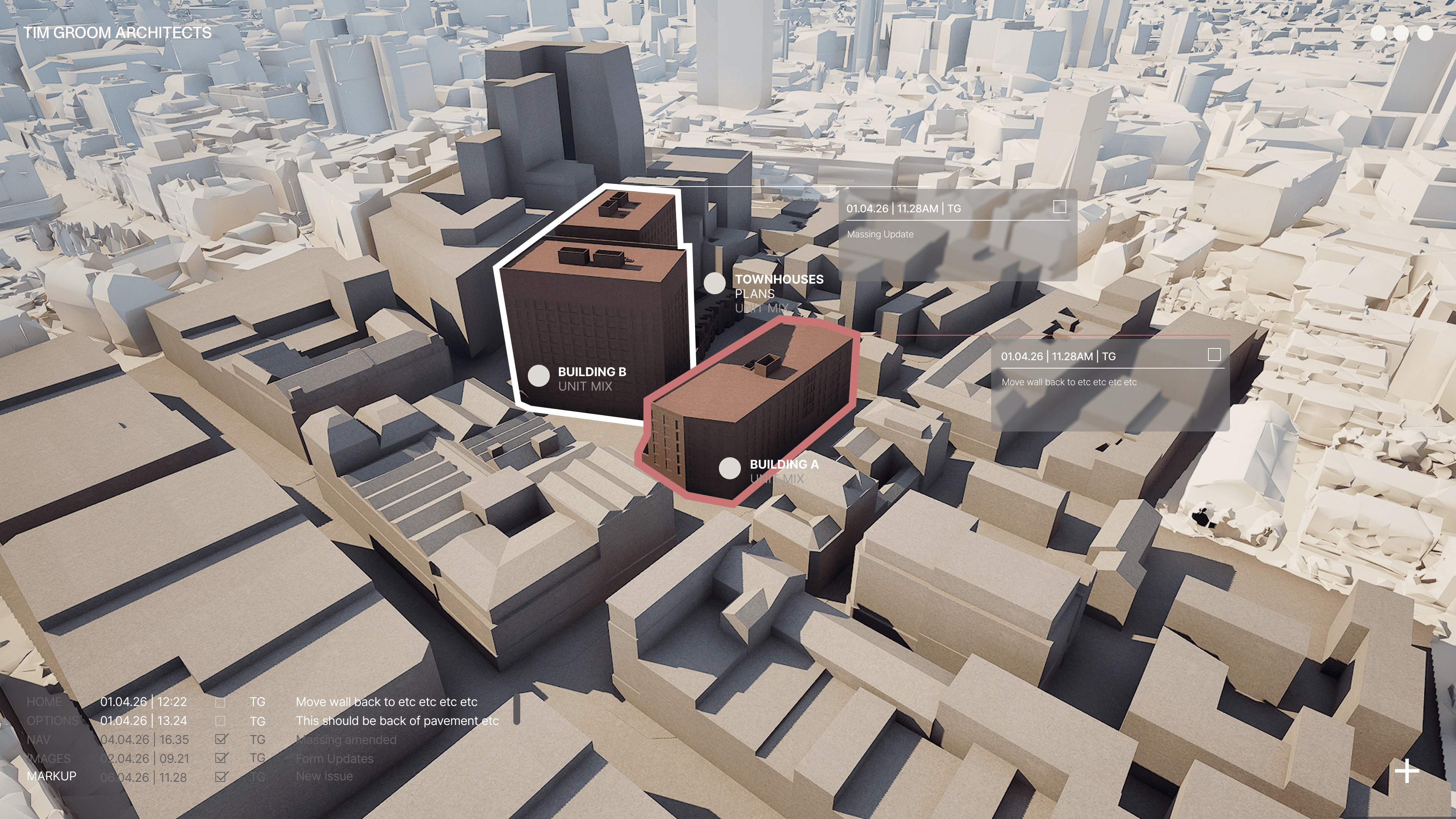
Bringing an evolving development masterplan into an interactive environment for design review, option testing and stakeholder communication.
Spatial Twin Development · Twin Applications

A
4D
Works Coordination
Coordinating airfield works, closures and operational constraints across location and time, with tools for assessing impacts and testing incidents.
Twin Applications · Systems & Data Integration
P
2D + 3D
Permit Coordination
Connecting permits, planned works and asset dependencies to identify spatial conflicts, coordinate activity and understand operational impacts.
Twin Applications · Systems & Data Integration
D
DXB
Airport Spatial Twin
A governed airport-wide spatial environment supporting design, stakeholder engagement and the progressive development of operational applications.
Spatial Twin Development · Twin Applications · Systems & Data Integration · Twin Custodianship
A
AIR + GROUND
Network Context
Exploring how future urban flight networks interact with the city below, including airspace constraints, flight corridors and ground-level risk.
Spatial Twin Development · Twin Applications · Systems & Data Integration
S
3D
Spatial Assessment
Assessing proposed developments and temporary works against protected airspace, making safeguarding constraints and potential infringements easier to identify.
Spatial Twin Development · Twin Applications
E
NETWORK
Spatial Coordination
Connecting rail infrastructure, asset information and planned works to improve visibility and coordination across a complex operational network.
Spatial Twin Development · Twin Applications · Systems & Data Integration
C
DESIGN
Project Development
Bringing an evolving development masterplan into an interactive environment for design review, option testing and stakeholder communication.
Spatial Twin Development · Twin Applications
A
4D
Works Coordination
Coordinating airfield works, closures and operational constraints across location and time, with tools for assessing impacts and testing incidents.
Twin Applications · Systems & Data Integration
How we work
Our agile approach establishes the spatial foundation around the long-term requirements of the asset, we then deploy applications and integrations as they are needed.

01
Define
We work with project and operational teams to define the problem, available information, users, systems and the outcomes the twin needs to support.
REQUIREMENTS · USE CASES · DATA · ROADMAP
02
Build the Foundation
We bring together the relevant BIM, GIS, 3D and survey information into a governed spatial foundation, structured around the requirements of the project or asset.
MODELS · STANDARDS · METADATA · GOVERNANCE
03
Develop & Connect
We develop the required applications and connect relevant project, asset and operational information — from design tools through to live systems and data.
APPLICATIONS · INTEGRATIONS · DATA · TESTING
04
Maintain & Evolve
We maintain the twin as the physical environment changes, adding new information, applications and integrations as requirements develop.
CUSTODIANSHIP · UPDATES · NEW MODULES · INTEGRATION
What we do
From the first model to live operational systems, we create, connect and maintain digital twins across the lifecycle of complex transport environments.
01
Create the governed spatial foundation.
We bring together BIM, GIS, 3D, survey and other spatial information to create a shared, real-time environment for the asset or network — establishing the structure, standards and governance needed for it to evolve over time.
One trusted spatial environment for the asset, project or network.
01
Create the governed spatial foundation.
We bring together BIM, GIS, 3D, survey and other spatial information to create a shared, real-time environment for the asset or network — establishing the structure, standards and governance needed for it to evolve over time.
One trusted spatial environment for the asset, project or network.
02
Build tools around real requirements.
We design and develop purpose-built applications for design, delivery and operations — from design review and stakeholder engagement to permits, works, possessions, passenger flow, safeguarding and operational visibility.
Practical tools that make complex spatial decisions easier and faster.
02
Build tools around real requirements.
We design and develop purpose-built applications for design, delivery and operations — from design review and stakeholder engagement to permits, works, possessions, passenger flow, safeguarding and operational visibility.
Practical tools that make complex spatial decisions easier and faster.
03
Connect existing information to place.
We connect project, asset and operational systems and data to the twin, giving information a spatial context and creating a shared view across otherwise disconnected systems.
Disconnected information brought together in its real-world context.
03
Connect existing information to place.
We connect project, asset and operational systems and data to the twin, giving information a spatial context and creating a shared view across otherwise disconnected systems.
Disconnected information brought together in its real-world context.
04
Maintain and evolve the environment.
We maintain the spatial environment, models, metadata, standards and integrations as the asset changes — while supporting new applications, systems, vendors and requirements over time.
A digital twin that stays current, governed and useful as the asset evolves.
04
Maintain and evolve the environment.
We maintain the spatial environment, models, metadata, standards and integrations as the asset changes — while supporting new applications, systems, vendors and requirements over time.
A digital twin that stays current, governed and useful as the asset evolves.

OUR APPROACH
Our twins are designed to be agile - remaining useful as projects, assets and requirements change — connecting what already exists and providing a foundation for what comes next.
ONE FOUNDATION
The same governed spatial foundation can support design, delivery and operations, without recreating the environment as requirements change.
Continuity across the lifecycle
OPEN & CONNECTED
Tomorrowspace connects to your existing systems, data and processes rather than trying to replace them — adding a shared spatial layer through which information can be understood together.
Integration without replacement
CUSTODIANSHIP
We can remain responsible for the twin's spatial integrity, governance and development, keeping it current as the physical environment changes.
What we leave behind
Questions, answered
Digital twins don't need to start as large transformation programmes. Here are some of the questions we are most often asked about how they can be established, integrated and maintained.
07
TALK TO TOMORROWSPACE
Whether you're exploring a digital twin, developing a specific use case or looking to build on an existing environment, tell us a little about what you're trying to achieve.
ABOUT
Complex environments generate huge amounts of information, but much of it remains split across different systems without a shared spatial context.
01
A trusted spatial reference for the asset, project or network. Bringing models and spatial information together within one governed environment that can be maintained throughout its lifecycle.
02
Understand what’s happening, where it’s happening and what it impacts. Purpose-built tools that turn spatial information into practical understanding across design, delivery and operations.
03
Connected systems and data understood in their real-world context. Creating the relationships between information, assets and activity needed for better analysis, simulation and decision-making.
PROJECTS + APPLICATIONS
From airport-wide spatial environments to focused applications for permits, possessions and operational coordination, each deployment responds to a defined project or operational need.
P
2D + 3D
Permit Coordination
Connecting permits, planned works and asset dependencies to identify spatial conflicts, coordinate activity and understand operational impacts.
Twin Applications · Systems & Data Integration
D
DXB
Airport Spatial Twin
A governed airport-wide spatial environment supporting design, stakeholder engagement and the progressive development of operational applications.
Spatial Twin Development · Twin Applications · Systems & Data Integration · Twin Custodianship
A
AIR + GROUND
Network Context
Exploring how future urban flight networks interact with the city below, including airspace constraints, flight corridors and ground-level risk.
Spatial Twin Development · Twin Applications · Systems & Data Integration
S
3D
Spatial Assessment
Assessing proposed developments and temporary works against protected airspace, making safeguarding constraints and potential infringements easier to identify.
Spatial Twin Development · Twin Applications
E
NETWORK
Spatial Coordination
Connecting rail infrastructure, asset information and planned works to improve visibility and coordination across a complex operational network.
Spatial Twin Development · Twin Applications · Systems & Data Integration
C
DESIGN
Project Development
Bringing an evolving development masterplan into an interactive environment for design review, option testing and stakeholder communication.
Spatial Twin Development · Twin Applications
A
4D
Works Coordination
Coordinating airfield works, closures and operational constraints across location and time, with tools for assessing impacts and testing incidents.
Twin Applications · Systems & Data Integration
P
2D + 3D
Permit Coordination
Connecting permits, planned works and asset dependencies to identify spatial conflicts, coordinate activity and understand operational impacts.
Twin Applications · Systems & Data Integration
D
DXB
Airport Spatial Twin
A governed airport-wide spatial environment supporting design, stakeholder engagement and the progressive development of operational applications.
Spatial Twin Development · Twin Applications · Systems & Data Integration · Twin Custodianship
A
AIR + GROUND
Network Context
Exploring how future urban flight networks interact with the city below, including airspace constraints, flight corridors and ground-level risk.
Spatial Twin Development · Twin Applications · Systems & Data Integration
S
3D
Spatial Assessment
Assessing proposed developments and temporary works against protected airspace, making safeguarding constraints and potential infringements easier to identify.
Spatial Twin Development · Twin Applications
E
NETWORK
Spatial Coordination
Connecting rail infrastructure, asset information and planned works to improve visibility and coordination across a complex operational network.
Spatial Twin Development · Twin Applications · Systems & Data Integration
C
DESIGN
Project Development
Bringing an evolving development masterplan into an interactive environment for design review, option testing and stakeholder communication.
Spatial Twin Development · Twin Applications
A
4D
Works Coordination
Coordinating airfield works, closures and operational constraints across location and time, with tools for assessing impacts and testing incidents.
Twin Applications · Systems & Data Integration
How we work
Our agile approach establishes the spatial foundation around the long-term requirements of the asset, we then deploy applications and integrations as they are needed.
01
Define
We work with project and operational teams to define the problem, available information, users, systems and the outcomes the twin needs to support.
REQUIREMENTS · USE CASES · DATA · ROADMAP
02
Build the Foundation
We bring together the relevant BIM, GIS, 3D and survey information into a governed spatial foundation, structured around the requirements of the project or asset.
MODELS · STANDARDS · METADATA · GOVERNANCE
03
Develop & Connect
We develop the required applications and connect relevant project, asset and operational information — from design tools through to live systems and data.
APPLICATIONS · INTEGRATIONS · DATA · TESTING
04
Maintain & Evolve
We maintain the twin as the physical environment changes, adding new information, applications and integrations as requirements develop.
CUSTODIANSHIP · UPDATES · NEW MODULES · INTEGRATION
What we do
From the first model to live operational systems, we create, connect and maintain digital twins across the lifecycle of complex transport environments.
01
Create the governed spatial foundation.
We bring together BIM, GIS, 3D, survey and other spatial information to create a shared, real-time environment for the asset or network — establishing the structure, standards and governance needed for it to evolve over time.
One trusted spatial environment for the asset, project or network.
01
Create the governed spatial foundation.
We bring together BIM, GIS, 3D, survey and other spatial information to create a shared, real-time environment for the asset or network — establishing the structure, standards and governance needed for it to evolve over time.
One trusted spatial environment for the asset, project or network.
02
Build tools around real requirements.
We design and develop purpose-built applications for design, delivery and operations — from design review and stakeholder engagement to permits, works, possessions, passenger flow, safeguarding and operational visibility.
Practical tools that make complex spatial decisions easier and faster.
02
Build tools around real requirements.
We design and develop purpose-built applications for design, delivery and operations — from design review and stakeholder engagement to permits, works, possessions, passenger flow, safeguarding and operational visibility.
Practical tools that make complex spatial decisions easier and faster.
03
Connect existing information to place.
We connect project, asset and operational systems and data to the twin, giving information a spatial context and creating a shared view across otherwise disconnected systems.
Disconnected information brought together in its real-world context.
03
Connect existing information to place.
We connect project, asset and operational systems and data to the twin, giving information a spatial context and creating a shared view across otherwise disconnected systems.
Disconnected information brought together in its real-world context.
04
Maintain and evolve the environment.
We maintain the spatial environment, models, metadata, standards and integrations as the asset changes — while supporting new applications, systems, vendors and requirements over time.
A digital twin that stays current, governed and useful as the asset evolves.
04
Maintain and evolve the environment.
We maintain the spatial environment, models, metadata, standards and integrations as the asset changes — while supporting new applications, systems, vendors and requirements over time.
A digital twin that stays current, governed and useful as the asset evolves.
OUR APPROACH
Our twins are designed to be agile - remaining useful as projects, assets and requirements change — connecting what already exists and providing a foundation for what comes next.
ONE FOUNDATION
The same governed spatial foundation can support design, delivery and operations, without recreating the environment as requirements change.
Continuity across the lifecycle
OPEN & CONNECTED
Tomorrowspace connects to your existing systems, data and processes rather than trying to replace them — adding a shared spatial layer through which information can be understood together.
Integration without replacement
CUSTODIANSHIP
We can remain responsible for the twin's spatial integrity, governance and development, keeping it current as the physical environment changes.
What we leave behind
Questions, answered
Digital twins don't need to start as large transformation programmes. Here are some of the questions we are most often asked about how they can be established, integrated and maintained.
07
TALK TO TOMORROWSPACE
Whether you're exploring a digital twin, developing a specific use case or looking to build on an existing environment, tell us a little about what you're trying to achieve.
ABOUT
Complex environments generate huge amounts of information, but much of it remains split across different systems without a shared spatial context.
01
A trusted spatial reference for the asset, project or network. Bringing models and spatial information together within one governed environment that can be maintained throughout its lifecycle.
02
Understand what’s happening, where it’s happening and what it impacts. Purpose-built tools that turn spatial information into practical understanding across design, delivery and operations.
03
Connected systems and data understood in their real-world context. Creating the relationships between information, assets and activity needed for better analysis, simulation and decision-making.
PROJECTS + APPLICATIONS
From airport-wide spatial environments to focused applications for permits, possessions and operational coordination, each deployment responds to a defined project or operational need.
P
2D + 3D
Permit Coordination
Connecting permits, planned works and asset dependencies to identify spatial conflicts, coordinate activity and understand operational impacts.
Twin Applications · Systems & Data Integration
D
DXB
Airport Spatial Twin
A governed airport-wide spatial environment supporting design, stakeholder engagement and the progressive development of operational applications.
Spatial Twin Development · Twin Applications · Systems & Data Integration · Twin Custodianship
A
AIR + GROUND
Network Context
Exploring how future urban flight networks interact with the city below, including airspace constraints, flight corridors and ground-level risk.
Spatial Twin Development · Twin Applications · Systems & Data Integration
S
3D
Spatial Assessment
Assessing proposed developments and temporary works against protected airspace, making safeguarding constraints and potential infringements easier to identify.
Spatial Twin Development · Twin Applications
E
NETWORK
Spatial Coordination
Connecting rail infrastructure, asset information and planned works to improve visibility and coordination across a complex operational network.
Spatial Twin Development · Twin Applications · Systems & Data Integration
C
DESIGN
Project Development
Bringing an evolving development masterplan into an interactive environment for design review, option testing and stakeholder communication.
Spatial Twin Development · Twin Applications
A
4D
Works Coordination
Coordinating airfield works, closures and operational constraints across location and time, with tools for assessing impacts and testing incidents.
Twin Applications · Systems & Data Integration
P
2D + 3D
Permit Coordination
Connecting permits, planned works and asset dependencies to identify spatial conflicts, coordinate activity and understand operational impacts.
Twin Applications · Systems & Data Integration
D
DXB
Airport Spatial Twin
A governed airport-wide spatial environment supporting design, stakeholder engagement and the progressive development of operational applications.
Spatial Twin Development · Twin Applications · Systems & Data Integration · Twin Custodianship
A
AIR + GROUND
Network Context
Exploring how future urban flight networks interact with the city below, including airspace constraints, flight corridors and ground-level risk.
Spatial Twin Development · Twin Applications · Systems & Data Integration
S
3D
Spatial Assessment
Assessing proposed developments and temporary works against protected airspace, making safeguarding constraints and potential infringements easier to identify.
Spatial Twin Development · Twin Applications
E
NETWORK
Spatial Coordination
Connecting rail infrastructure, asset information and planned works to improve visibility and coordination across a complex operational network.
Spatial Twin Development · Twin Applications · Systems & Data Integration
C
DESIGN
Project Development
Bringing an evolving development masterplan into an interactive environment for design review, option testing and stakeholder communication.
Spatial Twin Development · Twin Applications
A
4D
Works Coordination
Coordinating airfield works, closures and operational constraints across location and time, with tools for assessing impacts and testing incidents.
Twin Applications · Systems & Data Integration
How we work
Our agile approach establishes the spatial foundation around the long-term requirements of the asset, we then deploy applications and integrations as they are needed.
01
Define
We work with project and operational teams to define the problem, available information, users, systems and the outcomes the twin needs to support.
REQUIREMENTS · USE CASES · DATA · ROADMAP
02
Build the Foundation
We bring together the relevant BIM, GIS, 3D and survey information into a governed spatial foundation, structured around the requirements of the project or asset.
MODELS · STANDARDS · METADATA · GOVERNANCE
03
Develop & Connect
We develop the required applications and connect relevant project, asset and operational information — from design tools through to live systems and data.
APPLICATIONS · INTEGRATIONS · DATA · TESTING
04
Maintain & Evolve
We maintain the twin as the physical environment changes, adding new information, applications and integrations as requirements develop.
CUSTODIANSHIP · UPDATES · NEW MODULES · INTEGRATION
What we do
From the first model to live operational systems, we create, connect and maintain digital twins across the lifecycle of complex transport environments.
01
Create the governed spatial foundation.
We bring together BIM, GIS, 3D, survey and other spatial information to create a shared, real-time environment for the asset or network — establishing the structure, standards and governance needed for it to evolve over time.
One trusted spatial environment for the asset, project or network.
01
Create the governed spatial foundation.
We bring together BIM, GIS, 3D, survey and other spatial information to create a shared, real-time environment for the asset or network — establishing the structure, standards and governance needed for it to evolve over time.
One trusted spatial environment for the asset, project or network.
02
Build tools around real requirements.
We design and develop purpose-built applications for design, delivery and operations — from design review and stakeholder engagement to permits, works, possessions, passenger flow, safeguarding and operational visibility.
Practical tools that make complex spatial decisions easier and faster.
02
Build tools around real requirements.
We design and develop purpose-built applications for design, delivery and operations — from design review and stakeholder engagement to permits, works, possessions, passenger flow, safeguarding and operational visibility.
Practical tools that make complex spatial decisions easier and faster.
03
Connect existing information to place.
We connect project, asset and operational systems and data to the twin, giving information a spatial context and creating a shared view across otherwise disconnected systems.
Disconnected information brought together in its real-world context.
03
Connect existing information to place.
We connect project, asset and operational systems and data to the twin, giving information a spatial context and creating a shared view across otherwise disconnected systems.
Disconnected information brought together in its real-world context.
04
Maintain and evolve the environment.
We maintain the spatial environment, models, metadata, standards and integrations as the asset changes — while supporting new applications, systems, vendors and requirements over time.
A digital twin that stays current, governed and useful as the asset evolves.
04
Maintain and evolve the environment.
We maintain the spatial environment, models, metadata, standards and integrations as the asset changes — while supporting new applications, systems, vendors and requirements over time.
A digital twin that stays current, governed and useful as the asset evolves.
OUR APPROACH
Our twins are designed to be agile - remaining useful as projects, assets and requirements change — connecting what already exists and providing a foundation for what comes next.
ONE FOUNDATION
The same governed spatial foundation can support design, delivery and operations, without recreating the environment as requirements change.
Continuity across the lifecycle
OPEN & CONNECTED
Tomorrowspace connects to your existing systems, data and processes rather than trying to replace them — adding a shared spatial layer through which information can be understood together.
Integration without replacement
CUSTODIANSHIP
We can remain responsible for the twin's spatial integrity, governance and development, keeping it current as the physical environment changes.
What we leave behind
Questions, answered
Digital twins don't need to start as large transformation programmes. Here are some of the questions we are most often asked about how they can be established, integrated and maintained.
07
TALK TO TOMORROWSPACE
Whether you're exploring a digital twin, developing a specific use case or looking to build on an existing environment, tell us a little about what you're trying to achieve.